A new revolution in Paris

The line 1 of the Parisian subway is becoming automatic although no one notices it.

With 725 000 passengers daily and 111 years of existence, the most famous metro line of Paris, the first one ever set up in France, the Line 1, had to renew itself. It has been done this November 3rd; the first new MP05 rakes were inaugurated. They present a multitude of advantages: driverless, air-cooling and a low-noise system, and a better capacity (734 passengers standing up or 216 seating).

However, the main asset of this automation is the reduction of turn-over time between two trains from 105 secs to 85 secs.

But the great prodigy stands behind: Between 2007, year of the beginning of the process with the installation of PSDs along the metro stations, and 2011 the inauguration of the new rakes, there has not been a single interruption of traffic or any delays. Moreover, currently, both automatic and manual trains roll on the same rails (first time ever!). Furthermore, an agreement has been reached between the drivers and the RATP board to progressively elevate the drivers to new jobs such as “exploitation supervisor” or to redirect them to other lines.

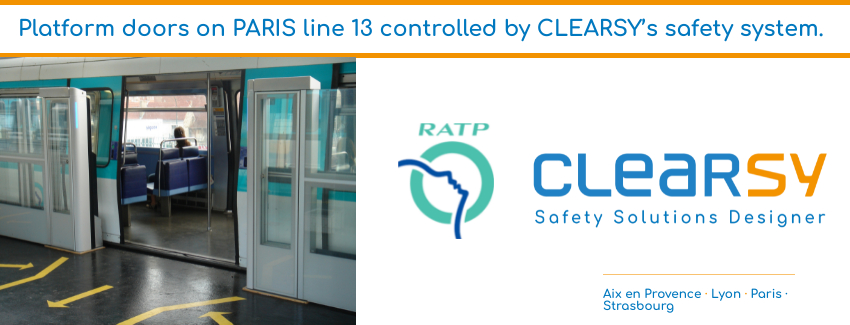
In a nutshell, the project is a total success. No doubts, the companies involved in the process will benefit from their work as a showcase of their respective abilities: Siemens for the automation, Alstom for the rolling stock, Kaba Gilgen for the Platform Screen Doors (PSD) and last but not less, Clearsy for its efficient and safe (SIL4) Platform Screen Doors Control System (PSDCS) – DOF1.


The revolution of the oldest Parisian Metro line.

Behind the modernization of the “line 1”

Les Sablons Station - © clicsouris - Licence CC

Les Sablons Station - © clicsouris - Licence CC

One of the oldest metro of the world, the mythic Parisian first line is now equipped with Platform Screen Doors (PSD). Created in 1900, the most famous metro of Paris lives a true revolution. Indeed, the present-day line includes both automatic trains (52) and PSDs in 26 stations. Thus the main line of Paris has become safer, strike-proof and the very quality of the transport has been upgraded by the change of the rolling stock.

However, this is only the ostentatious part of this renewal. The more interesting for us is the hidden side of the very routine of the passing trains at a station… the opening and closing of Platform Screen Doors. As an iceberg which moves the way it does, only because of its invisible part, the PSDs are controlled by a discreet and far more predictable and safer system…

The keystone of critical safety

This Platform Screen Doors Control/Command System (PSDCS) is SIL3. It means that the probability of the doors opening without a train, or with a bad placed one, is inferior to 10-7 (0.000001) per hour. According to the IEC 61508, it is the second safest accreditation in railway-systems behind SIL4 which is not relevant here. The efficiency of the system is based on a simple process. A train enters a station; doing this, it rolls over a kind of narrow black carpet (on the way, at the middle of the station, between the rails). There is also an on-board transmitter in the middle of the train. If the train stops at the right place, the transmitter will be above the carpet and will form a magnetic loop between the train and the ground (the platform). This magnetic-loop enables the communications between the train and the platform and thus, the orders of opening/closing the PSDs to be transmitted from the train to the platform. This is a fail-safe system.

This PSD Control System called DOF1 (like a dolphin in French) is nothing but the paragon of a technology, the Formal B Method – a language which enables its users to translate specifications into a formal dialect(one word, one meaning) which is automatically analyzed to determine if there exists contradictions between those specs. This method can be used to design bug-less software or very safe systems.

Clearsy, the know-how to combine availability and dependability.

Clearsy, the company which succeeded in designing the PSDC system is a French corporation specialized in safety critical engineering and the world leader in the use of the Formal Method B. Its Fersil range dedicated to rail-ways includes two other PSDC systems, visible in Paris 13th line and Sao Polo 2nd and 3rd line. Clearsy also created various safety systems from axels-counter to gap-fillers.


ClearSy presents its new railway product : the DRF-MP

Le DRF-MPClearSy is pleased to announce the release of a new product in its range of railway products: the DRF-MP, a wheel sensor specially developped for the detection of tire-mounted metro.

By its form and its sensitivity different from the  standard DRF, this system can be adapted to any type of  tire-mounted metro, but also trams, whithout having to cut the groove of the rail.

For now, this system is being tested on line 1 of the Paris Metro…


AI4FM 2011

AI4FM

AI4FM 2011

ClearSy is taking part in the AI4FM 2011 workshop, which will be held on 28 and 29 April 2011 at Edinburgh university (More informations…).
The aim of the AI4FM project is to introduce some Artificial Intelligence techniques in order to optimise the automatic demonstration of mathematic models.
As guest speaker, Thierry Lecomte will present “Yet Another Theorem Prover in Distress”.


APM-ATS 2011

APM-ATSClearSy is pleased to announce its participation to the APM-ATS 2011 conference, which will take place from 22 to 26 May 2011, in Palais des Congrès, Paris.

This fair is aimed at gathering together the greatest protagonists of the railway world around the automation transport question… It meets every two years, hundreds of specialists: engineers, researchers, planners and business decision makers, operators, authorities and organizing offices.


Rhônexpress – Test of Automatic Stop Train KFS SIL2 (ATS – DAAT SIL2)

Rhônexpress Tramway - Lyon

Rhônexpress Tramway - Lyon

The KFS SIL2 system, a SIL2 certified automatic train stop mechanism (DAAT), distributed by Fersil, underwent testing by night, holding off passengers from 27th September to 1st October 2010, on Lyon’s Rhonexpress tramway. The latter is a tramway which has the characteristic of reaching a speed of 100km/hour to make the link between Lyon’s City-Centre/Saint Exupéry Airport in less than 30 minutes.

Due to this high speed, the group responsible for the creation of the line has decided to install a DAAT. As such it has selected the KFS SIL2 developed by ClearSy, which is in charge of automatically stopping any train that passes a shut signal. These tests were carried out by Vossloh-Cogifer, the company in charge of the signalling in this matter, on the section between the Depot/St Exupéry airport, at a speed of 10km/hr, then 100km/hr. This testing enabled the following to be checked:

  • the operational aspect of the SIL2 level DAAT equipment (onboard KFS sensor, Beacon on the KFSI track, and onboard KFS Processing Framework)
  • the compatibility and the interaction of the material used (in view of the replacement of the DAAT SILO equipment with the DAAT SIL2 equipment)
  • the setting in motion of the emergency braking in the event of passing the signal
  • the lack of wrong emergency braking
  • the communication between the various pieces of equipment: sensors, beacons and frameworks, via control of the wiring
  • the temporary inhibition function
  • the permanent inhibition function
  • the operation of the Gong

The tests were run over 5 nights and proved conclusive: the DAAT reacted positively to all the scheduled tests, thus confirming the smooth running of the system developed by ClearSy and certified by Certifer.

The bringing into service of the SIL2 system is scheduled for April 2011, with a gradual replacement of the current system (SIL0) with the SIL2 system.


KFS SIL2 Currently being tested on the Rhonexpress, Lyon’s new tramway

Rhônexpress Tramway - Lyon

Rhônexpress Tramway - Lyon

Lyon’s new “Rhonexpress” tramway, is equipped with the KFS SIL2 system, an Automatic Train Stop Mechanism (DAAT), currently being tested by night, holding off passengers in its SIL2 version.

Lyon’s “Rhonexpress” tramway has the characteristic of having a single track on which trains will be able to reach the speed of 100km/hr in order to get from the station in Lyon to Saint Exupéry airport in under 30 minutes. It is this special feature which motivated the implementation of an automatic train stop system in the event that signals are passed through wrongly.

In this way, KFS SIL2 (SIL2 certified by Certifer under reference ECI_1462_0005 – 26/07/2010 and developed by ClearSy), will soon be in use on the tramways of the Rhone Express network. For the time being, this system is currently undergoing testing and the initial trials have been conclusive.

Operating principles of the KFS SIL2 (DAAT)

The KFS system operates from three elements:

  • an onboard KFS sensor
  • a KFSI beacon installed on the ground on the track
  • an onboard KFS processing block or framework

The principle behind it is simple: the onboard KFS sensor detects an electro-magnetic (or magnetic) field, emitted by a KFSI beacon, installed on the ballast between the running rails via the intermediary of an external chassis, and relayed to the manoeuvre protection signal. The KFS sensor sends the information picked up at the KFS processing block, which is responsible for decoding it and passing on the information for the emergency braking or the driver’s alarm, which in turn triggers the halting of the tramway.


New York City Metro : Automatisation of Flushing and Culver Lines

Battelle has signed a contract with ClearSy for a collaboration within the framework of the automation project of the Flushing and Culver metro lines in New York City.

Indeed, Battelle has been selected to be the Independent Safety Assessor (ISA) for these two lines. This 6 yearsn 6,7m$ project, consists in equipping these lines with a CBTC (Communication-Based Train Control), in order to improve New York metro traffic while ensuring passengers safety.

This system comprises, among other things :

  • a CBTC (embedded pilot and trackside stations)
  • a Central Command Center
  • signalling devices

Battelle has decided to collaborate with TÜV Rheinland Rail Sciences, Turner Engineering Corporation, Transport Resource Associates, Metro Tech Consulting Services and ClearSy.

ClearSy was specifically given the responsability to model formally the whole system by using the B Method that is a formal method based on the B language, refinement, and mathematical proofs. This modelling would enable to improve system safety confidence and to ensure high level of coherency and correction to each equipment specification document.

The B Method is used in the railway domain more particularly to develop safety critical software as train automatic pilots.